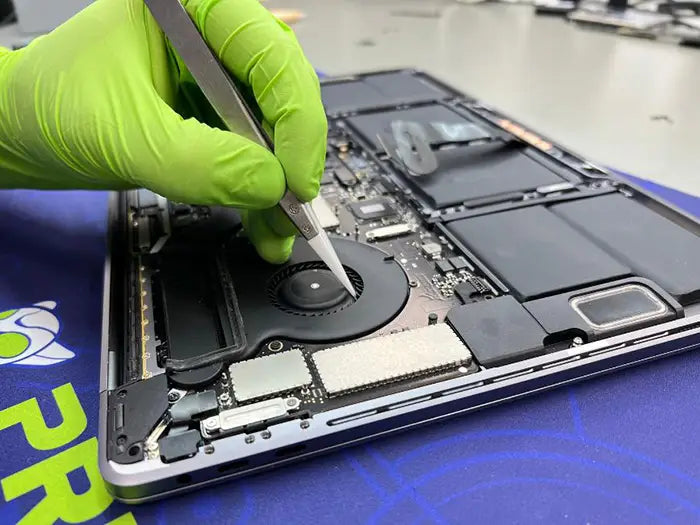
MacBook Black Screen but Still On? Causes, Diagnosis & Repair Options
A MacBook with a black screen can look completely dead at first — but in many cases, the computer is still running normally in the background. You may hear the startup sound, feel the trackpad click, see keyboard backlighting, or even notice the fans spinning while the display stays completely dark.
This situation is commonly misunderstood because a “black screen” does not always mean the display itself has failed. On modern MacBooks, the display system depends on multiple components working together, including the LCD panel, backlight circuit, display flex cables, graphics communication, and logic board power rails. A failure anywhere in that chain can leave the computer powered on while showing no visible image.
Some black screen issues are caused by physical display damage, while others are related to Flexgate cable wear, backlight failures, liquid damage, failed display circuits, or even corrupted macOS updates. In some situations, the internal screen may stop working entirely while the MacBook continues functioning normally through an external monitor.
We frequently see customers replace screens unnecessarily because the real issue was hidden deeper inside the logic board or display power system. In other cases, software troubleshooting wastes time while a hardware fault continues worsening internally.
MacBook Screen Suddenly Went Black?
Professional diagnostics can identify whether the problem is related to the display, backlight circuit, flex cable, or logic board before unnecessary parts are replaced.
Schedule a MacBook Screen DiagnosticIn this guide, we’ll explain what causes a MacBook black screen while the computer is still powered on, how to narrow down the possible failure, and what repair options are typically available depending on the underlying issue.
Table of Contents
What Does “Black Screen but Still On” Actually Mean?
When technicians describe a MacBook as “still on,” they mean the computer itself is successfully powering up even though the display appears completely black. This distinction matters because it changes the entire diagnostic process.
A fully dead MacBook usually shows no signs of power at all. But a MacBook with a black screen may still be booting into macOS normally behind the scenes while the display system fails to present the image properly.

Signs the MacBook Is Still Powered On
Several symptoms can indicate the computer itself is functioning despite the screen remaining dark:
- Keyboard backlight turns on
- Trackpad provides haptic feedback
- Fans begin spinning after startup
- Charging sound or boot chime is heard
- Touch Bar responds normally
- Caps Lock key activates its indicator light
- External monitor displays video output
These clues help separate display-related failures from full logic board power failures. In many repair cases, the MacBook itself is actually operating correctly while only the image delivery system has stopped functioning.
Why the Display System Is More Complex Than Most People Realize
Modern MacBook displays are not controlled by a single cable or single component. The screen assembly relies on several systems working together simultaneously:
- LCD or Retina display panel
- Backlight circuitry
- Display flex cables
- Display timing and communication signals
- Graphics processing communication
- Logic board power delivery circuits
A failure in any one of these areas can create a black screen symptom even though the computer itself still boots normally. This is why accurate diagnostics are so important before replacing parts.
For example, some MacBooks affected by Flexgate display cable failure may initially show intermittent flickering before eventually progressing into a completely black screen at certain display angles.
Not Every Black Screen Requires Full Screen Replacement
In some cases, the LCD panel itself is perfectly functional. The actual failure may involve the backlight system, display communication circuitry, or damaged flex cables instead of the screen panel.
Common Causes of a MacBook Black Screen
A MacBook screen can go black for several very different reasons, which is why proper diagnosis matters so much before replacing parts. Two MacBooks with identical symptoms may require completely different repairs internally.
In some situations, the problem is limited to the backlight system. In others, the display cable may be failing from repeated lid movement, or the logic board itself may no longer be sending proper video signals to the screen.
Understanding the most common failure points helps narrow down what may actually be happening inside the computer.
Backlight Failure
One of the most common causes of a “black screen but still on” situation is backlight failure. In these cases, the LCD panel may still be generating an image, but the screen has no illumination, making it appear completely black under normal lighting conditions.
This often happens when the backlight circuit on the logic board fails due to electrical damage, liquid exposure, failed components, or shorted display lines.

A common diagnostic method is the flashlight test. When a bright light is aimed closely at the display, a very faint image may still be visible underneath the dark screen. This strongly suggests the LCD panel is functioning while the backlight system has stopped working.
Flexgate and Display Cable Damage
Some MacBook models develop black screen problems because the display flex cable wears out over time. This issue became widely known as Flexgate and is especially common in certain MacBook Pro generations.
The flex cable bends every time the lid opens and closes. After repeated stress cycles, the cable may begin failing intermittently before eventually causing complete display loss.
Many Flexgate cases begin with:
- Stage light effect at the bottom of the screen
- Flickering while moving the lid
- Brightness inconsistencies
- Image loss at certain angles
Eventually, the display may remain fully black depending on screen position.
We covered this issue in detail in our guide about MacBook Flexgate screen flickering problems .

Logic Board Display Circuit Failure
In more advanced cases, the issue originates directly on the logic board itself. The display relies on multiple voltage rails and communication circuits to function correctly. If one of these circuits fails, the screen may stop receiving proper video or backlight power entirely.
Common causes include:
- Liquid damage corrosion
- Shorted backlight lines
- Burned display ICs
- Power rail instability
- Previous improper repair attempts
Logic board display failures are frequently misdiagnosed as “bad screens,” leading to unnecessary full display replacements that do not solve the problem.
Why Board-Level Diagnostics Matter
Replacing the display without testing the logic board can lead to major unnecessary expenses. We regularly see MacBooks where the original screen was fully functional and the actual failure existed inside the display power circuitry.
Software or macOS Corruption
Not every black screen problem is hardware-related. In some cases, macOS itself fails during boot because of corrupted system files, failed updates, incompatible startup items, or software conflicts.
This can sometimes create symptoms such as:
- Black screen after Apple logo
- Display turns black during login
- External monitor still functioning normally
- Boot loops after updates
Software-related black screen issues are generally less common than hardware failures in repair environments, but they still need to be ruled out during diagnosis.
Display Panel Failure
Physical damage to the LCD or Retina panel itself can also cause a fully black display. Unlike backlight failures, panel failures often happen after:
- Pressure damage inside backpacks
- Liquid exposure
- Drops or impacts
- Lid torsion or twisting
Some panel failures show visible cracks or lines, while others fail internally without obvious external damage.
If your MacBook previously showed flickering, colored lines, or image distortion before the black screen appeared, the issue may be related to a failing display assembly rather than the logic board itself.
You can also review our related guide covering MacBook screen issues including lines, flickering, and black screens .
How to Tell if It’s the Screen or the Logic Board
One of the biggest challenges with MacBook black screen issues is determining whether the problem originates from the display assembly itself or from the logic board controlling it. Since both failures can produce very similar symptoms, accurate testing is essential before replacing expensive parts.
A proper diagnosis usually involves multiple tests rather than relying on a single symptom alone.
External Monitor Testing
One of the fastest ways to narrow down the problem is by connecting the MacBook to an external monitor or TV using HDMI, USB-C, or Thunderbolt depending on the model.

If the external monitor displays video normally while the internal screen remains black, this usually indicates:
- Display assembly failure
- Backlight failure
- Display flex cable damage
- Internal display communication issue
In these situations, the graphics system and main logic board are often still functioning correctly because the MacBook can continue generating video output externally.
However, external display testing is not always conclusive. Some logic board failures affect only the internal display circuitry while external video continues functioning normally.
Bright Flashlight Test
The flashlight test is commonly used to identify backlight-related failures. In a dark room, a strong flashlight is aimed closely against the display surface while the MacBook is powered on.
If a faint image becomes visible underneath the black screen, the LCD panel itself is usually still producing an image, but the backlight system has failed.
This test helps separate:
- Backlight circuit failures
- Backlight fuse issues
- Display power problems
from fully dead display panels.
Angle Testing
Some MacBooks develop black screen problems only when the display is opened to certain angles. This is especially common with worn display flex cables associated with Flexgate-related failures.
During testing, technicians slowly move the display through different positions while monitoring for:
- Intermittent image return
- Flickering
- Backlight changes
- Sudden blackouts
If the image returns temporarily while adjusting the lid angle, the issue often points toward cable fatigue rather than a fully failed LCD panel.
Recovery Mode Behavior
Booting into macOS Recovery Mode can sometimes help determine whether the problem is software-related.
If the screen appears normally in Recovery Mode but goes black during standard startup, possible causes may include:
- Corrupted macOS installation
- Login item conflicts
- Graphics driver issues
- Failed system updates
On the other hand, if the display remains black even in Recovery Mode, hardware issues become more likely.
Apple Silicon vs Intel MacBook Differences
Apple Silicon MacBooks and Intel-based MacBooks can behave differently during black screen failures.
Intel models often rely on traditional SMC and NVRAM reset procedures during troubleshooting, while Apple Silicon systems handle startup management differently because many controllers are integrated directly into the main chip architecture.
Additionally, Apple Silicon devices may present fewer visible diagnostic clues because of their tightly integrated hardware design.
Modern MacBooks Require More Advanced Diagnostics
As Apple hardware becomes more integrated, distinguishing between display, power, and logic board failures often requires board-level testing equipment rather than simple part swapping.
| Symptom | Possible Cause | Common Repair Direction |
|---|---|---|
| External monitor works normally | Display or backlight issue | Display diagnostics or board-level repair |
| Faint image visible with flashlight | Backlight failure | Backlight circuit repair |
| Screen changes when lid moves | Flex cable damage | Display cable or screen repair |
| No image internally or externally | Logic board failure | Board-level diagnostics |
| Black screen after macOS update | Software corruption | Recovery or system repair |
Real Repair Case From the Lab
One recent repair case involved a MacBook Pro that appeared completely unusable to the customer. The computer powered on normally, the keyboard backlight worked, and the trackpad still responded with haptic feedback, but the internal display remained entirely black.
The customer initially believed the screen itself had failed and was preparing for a full display replacement. However, during intake testing, several details suggested the issue might be deeper than the LCD panel alone.
When connected to an external monitor, the MacBook displayed video output normally. This immediately confirmed that the computer itself was still booting into macOS correctly and that the graphics processing system remained functional.

Further testing using a flashlight against the internal display revealed a faint image hidden beneath the black screen. This pointed toward a backlight-related failure rather than a dead LCD panel.
After disassembly and microscope inspection, the actual problem was traced to damage within the backlight power circuitry on the logic board. The display itself was still functional.
In this case, replacing the entire display assembly would not have solved the problem because the screen was never the root cause.
Why Misdiagnosis Happens So Often
Black screen symptoms are difficult because multiple failures can look nearly identical from the outside. A failed backlight circuit, damaged flex cable, dead LCD panel, or display communication problem may all produce what appears to be the exact same symptom to the user.
This is why many repair attempts become expensive trial-and-error situations instead of structured diagnostics.
We regularly see MacBooks that already had:
- Unnecessary screen replacements
- Repeated software reinstalls
- Aftermarket display installations
- Improper DIY repair attempts
before the actual hardware failure was correctly identified.
Board-Level Repair vs Full Display Replacement
In many modern MacBooks, the display assembly is one of the most expensive components in the entire computer. But not every black screen situation requires replacing the entire screen assembly.
Depending on the diagnosis, repairs may involve:
- Backlight circuit restoration
- Fuse replacement
- Flex cable repair
- Corrosion cleanup after liquid exposure
- Display connector repair
Accurate diagnostics help determine whether the problem exists:
- Inside the display assembly
- Within the logic board circuitry
- In the display communication path
- Or within software and startup systems
Why Professional Diagnostics Matter
Replacing parts without confirming the actual failure can dramatically increase repair costs. Many MacBook black screen cases require electrical testing and microscope inspection before the correct repair path becomes clear.
For users dealing with severe startup or display-related failures, it’s also important to consider potential data protection strategies. If the MacBook eventually stops booting entirely, professional Mac data recovery procedures may become necessary before attempting additional repair work.
Can You Fix a Black Screen Yourself?
Some MacBook black screen situations can be narrowed down with a few basic checks at home, especially when the issue is related to temporary software instability or simple display settings. However, many modern MacBook display failures involve delicate hardware systems that can easily become worse during improper DIY repair attempts.
Understanding which tests are reasonably safe — and which repairs should be left to professional diagnostics — can help avoid unnecessary damage.
Safe Checks You Can Perform at Home
Before assuming the MacBook requires major hardware repair, there are several basic diagnostic steps users can safely try.
Test an External Monitor
Connecting the MacBook to an external display can quickly help determine whether the computer itself is still functioning normally.
If video appears externally while the internal screen remains black, the problem is more likely related to:
- Display assembly failure
- Backlight circuitry
- Flex cable damage
- Internal display communication issues
Check Brightness and Power
In some situations, the display brightness may accidentally be reduced completely or the system may fail to wake properly from sleep.
Users can safely verify:
- Brightness controls
- Charger functionality
- Battery charging indicators
- Power adapter connection stability
Perform Basic Startup Resets
Intel-based MacBooks may sometimes respond to SMC or NVRAM reset procedures when startup behavior becomes unstable after software crashes or failed updates.
While these resets do not repair physical hardware damage, they can occasionally resolve:
- Sleep wake issues
- Temporary display initialization problems
- Power management irregularities
Apple Silicon MacBooks handle startup management differently and generally rely more on Recovery Mode diagnostics rather than traditional SMC resets.
What You Should Avoid Doing
Many MacBook display systems are extremely fragile internally. Attempting repairs without proper tools, schematics, or experience can quickly turn a repairable issue into a much larger hardware failure.
Forcing the Display Open
If the screen only works at certain angles, some users repeatedly force the lid open and closed attempting to “find the right position.” Unfortunately, this often accelerates flex cable damage and may permanently tear weakened display cables.
Disconnecting the Battery Incorrectly
Opening a MacBook without following proper battery isolation procedures can create severe electrical damage. Certain display and backlight circuits are especially vulnerable to shorting if connectors are disconnected while power remains active on the board.
We regularly see cases where a simple display issue became a logic board repair after improper DIY disassembly attempts.
Installing Cheap Replacement Displays
Online replacement screens vary dramatically in quality. Some low-cost assemblies may introduce:
- Brightness inconsistencies
- Premature cable failure
- Poor color reproduction
- Intermittent display behavior
- Backlight instability
In certain situations, aftermarket parts can complicate future diagnostics because new symptoms appear after installation.
Modern MacBooks Are Highly Integrated
Newer MacBook designs combine display communication, backlight systems, and power circuitry into tightly integrated hardware layouts. Accurate diagnosis often requires microscope inspection, electrical measurements, and board-level testing tools.
If the MacBook contains important files and the system begins showing worsening startup behavior in addition to the black screen, it may also be wise to prioritize protecting the data before attempting additional repair work.
Our guide on MacBook data recovery from non-booting systems explains how data protection becomes increasingly important when hardware failures continue progressing.
Repair Options for MacBook Black Screen Issues
The correct repair approach for a MacBook black screen depends entirely on what failed inside the display system. Since several different hardware and software problems can create nearly identical symptoms, professional diagnostics are usually the most important step before replacing parts.
Some black screen situations require only targeted circuit repair, while others may involve full display replacement or deeper logic board restoration work.
Backlight Circuit Repair
If flashlight testing reveals a faint image underneath the black screen, the LCD panel itself may still be functional while the backlight system has failed.
In these situations, repair work often focuses on restoring the backlight circuitry rather than replacing the entire display assembly.
Depending on the model and type of damage, repairs may involve:
- Backlight fuse replacement
- Backlight driver IC repair
- Voltage rail restoration
- Shorted line repair
- Corrosion cleanup after liquid exposure
In many successful cases, the original screen can remain fully usable after the backlight circuitry is restored correctly.
Flex Cable or Display Cable Repair
MacBooks affected by Flexgate-related failures may require repair involving the display communication cable system.
Common symptoms include:
- Black screen at certain lid angles
- Intermittent image return
- Stage light effect
- Screen flickering before total failure
Depending on the specific MacBook model and extent of the damage, repairs may involve:
- Display cable replacement
- Complete display assembly replacement
- Connector-level repair
We explain this issue further in our article covering Flexgate screen flickering and display cable failures .
Full Screen Replacement
Some MacBook black screen issues are caused by direct physical failure of the display assembly itself. This may happen after:
- Impact damage
- Internal LCD cracking
- Pressure damage
- Severe liquid exposure
- Display layer separation
In these cases, replacing the display assembly may be the most reliable solution.
However, it is important to confirm the screen is truly defective before replacing it. Since modern MacBook displays are expensive, accurate diagnostics can prevent unnecessary replacement costs.
Logic Board Repair
If the problem originates within the logic board display circuitry, board-level repair may be necessary.
This often includes:
- Replacing failed display ICs
- Repairing damaged power rails
- Cleaning corrosion damage
- Restoring shorted display lines
- Repairing connector-level damage
Logic board display failures are especially common after liquid exposure, electrical shorts, or previous improper repair attempts.
These repairs generally require microscope work and specialized board-level diagnostic equipment.
Data Recovery Considerations
If the MacBook begins showing worsening startup behavior in addition to the black screen, protecting the data may become a priority before additional repair attempts continue.
Some systems initially present only a display issue before later developing:
- No boot symptoms
- Storage communication failures
- Liquid-damage progression
- Power instability
In these situations, professional MacBook data recovery services may help preserve important files before further hardware deterioration occurs.
Need Professional MacBook Black Screen Diagnostics?
Whether the issue involves Flexgate, backlight failure, display damage, or logic board circuitry, accurate diagnostics are critical before replacing expensive parts unnecessarily.
Schedule a MacBook Screen Repair EvaluationConclusion
A MacBook black screen does not always mean the computer is dead or that the display itself has failed. In many cases, the system is still fully powered on while a problem inside the backlight system, display cable, display circuitry, or logic board prevents the image from appearing normally.
Because modern MacBooks use highly integrated display systems, accurate diagnostics matter more than ever before replacing parts. A failed backlight circuit can look identical to a dead screen, while a worn flex cable may mimic a logic board issue.
Proper testing helps determine whether the problem involves:
- The display assembly itself
- Backlight power circuitry
- Flex cable wear
- Logic board communication
- Software corruption
In many situations, early diagnosis can prevent additional damage and avoid unnecessary replacement costs.
If your MacBook previously showed flickering, stage lighting, brightness instability, or intermittent image loss before going fully black, those symptoms may provide important clues about the underlying failure.
You can also review our related guides covering:
Share this

Related Mac Repair Articles


Frequently Asked Questions MacBook Black Screen but Still On
Why is my MacBook screen black but the keyboard lights still work?
Can a MacBook black screen be fixed without replacing the display?
Does Flexgate cause black screen problems?
Can liquid damage cause a black screen later?
Why does my MacBook work on an external monitor only?
Is a black screen always a logic board issue?
How do I know if my MacBook backlight failed?
MacBook Not Working? Get Expert Diagnosis and Repair Options
If your MacBook is experiencing issues, getting a proper diagnosis is the first step. Many problems that seem like major failures can often be resolved with targeted component-level repairs.
At Prime Tech Support, we specialize in advanced MacBook diagnostics and repairs, including issues that other shops may not be able to resolve.
In Miami? Get Local Mac Repair Service
Our team is ready to help you . We offer same-day repairs
Not in Miami? Use Our Mac Mail-In Repair Service
We offer secure nationwide mail-in repairs with fast turnaround times and professional diagnostics.
Explore More MacBook Repair Guides
View all-

A MacBook SSD upgrade is possible on certain older MacBook Pro and MacBook Air models, but newer models use storage...
MacBook SSD Upgrade: Can Your Model Be Upgraded—and Is It Wort...
A MacBook SSD upgrade is possible on certain older MacBook Pro and MacBook Air models, but newer models use storage...
-

MacBook storage problems can involve much more than a failed SSD. Learn how removable and soldered MacBook storage works, common...
MacBook SSD Repair and Upgrade: Complete Guide to Storage Prob...
MacBook storage problems can involve much more than a failed SSD. Learn how removable and soldered MacBook storage works, common...
-

Is your MacBook running hot but the fan is completely silent? Learn how to determine whether your MacBook has a...
MacBook Fan Not Working Diagnostics and Repair
Is your MacBook running hot but the fan is completely silent? Learn how to determine whether your MacBook has a...